Welcome to my clinical kala red light therapy mask review. As a Registered Massage Therapist and clinical researcher, I constantly evaluate devices promising measurable cellular optimization. The Kala Red Light Face Mask immediately caught my attention. It delivers three therapeutic wavelengths—630nm red, 830nm near-infrared, and 465nm blue—in a single medical-grade silicone device. This triple-wavelength approach separates it from the vast majority of at-home LED masks.

The Kala Red Light Face Mask earns its place as a top-tier clinical tool. Its triple-wavelength coverage, featuring 66 medical-grade triple-chip LEDs, makes it one of the most complete options available. If your skin goals include any combination of fine lines, inflammation, rosacea, or acne, this mask addresses all of them effectively.

Get 15% Off the Kala Red Light Mask
15% off applied automatically through this link
Key specs at a glance
| Spec | Kala Red Light Face Mask |
|---|---|
| Wavelengths | 630nm red, 830nm NIR, 465nm blue |
| LED count | 66 medical-grade triple-chip LEDs |
| Irradiance | Red: 20 mW/cm² | NIR: 10 mW/cm² | Blue: 10 mW/cm² |
| Dimensions | 298mm × 216mm × 5.1mm |
| Material | Medical-grade silicone |
| Charging | USB-C, ~4 hours full charge |
| Regulatory clearance | FDA-cleared, Health Canada cleared |
| Warranty | 2 years |
| Return policy | Final sale (no 30-day return on the mask) |

Clinical observations: 90 days with the Kala mask
I tested this mask personally for 90 days to address hormonal jawline acne and recurring eczema patches. I prescribed myself 15-minute sessions, 4-5 times per week on clean, dry skin. Within three weeks, my eczema flare-ups shortened significantly. By week six, the blue light had visibly suppressed my active acne breakouts, while the red light rapidly cleared the residual inflammation.
I also monitored a patient in my private clinic with chronic, treatment-resistant facial eczema. We added the Kala mask to their home care plan. Over eight weeks, we documented a drastic reduction in scaling and a visibly rebuilt skin barrier. This specific clinical response solidified my confidence in the hardware.
Irradiance and biological mechanisms
The Kala mask's light output is precisely calibrated. The 630nm red channel delivers 20 mW/cm². This aligns with a 2014 controlled trial demonstrating significant collagen density improvements and fine line reduction (Wunsch & Matuschka, PMID: 24286286).
The 830nm near-infrared (NIR) light penetrates deeper at 10 mW/cm² to modulate inflammatory cytokines. The lower irradiance for NIR is intentional, allowing it to reach deeper cellular structures without surface heat.
What makes this device unique is the 465nm blue light. It destroys Propionibacterium acnes bacteria on contact. A pivotal 2000 clinical trial confirmed that combining blue and red light effectively treats inflammatory acne by targeting both the bacteria and the resulting inflammation (Papageorgiou et al., PMID: 10809858).
Hardware and usability
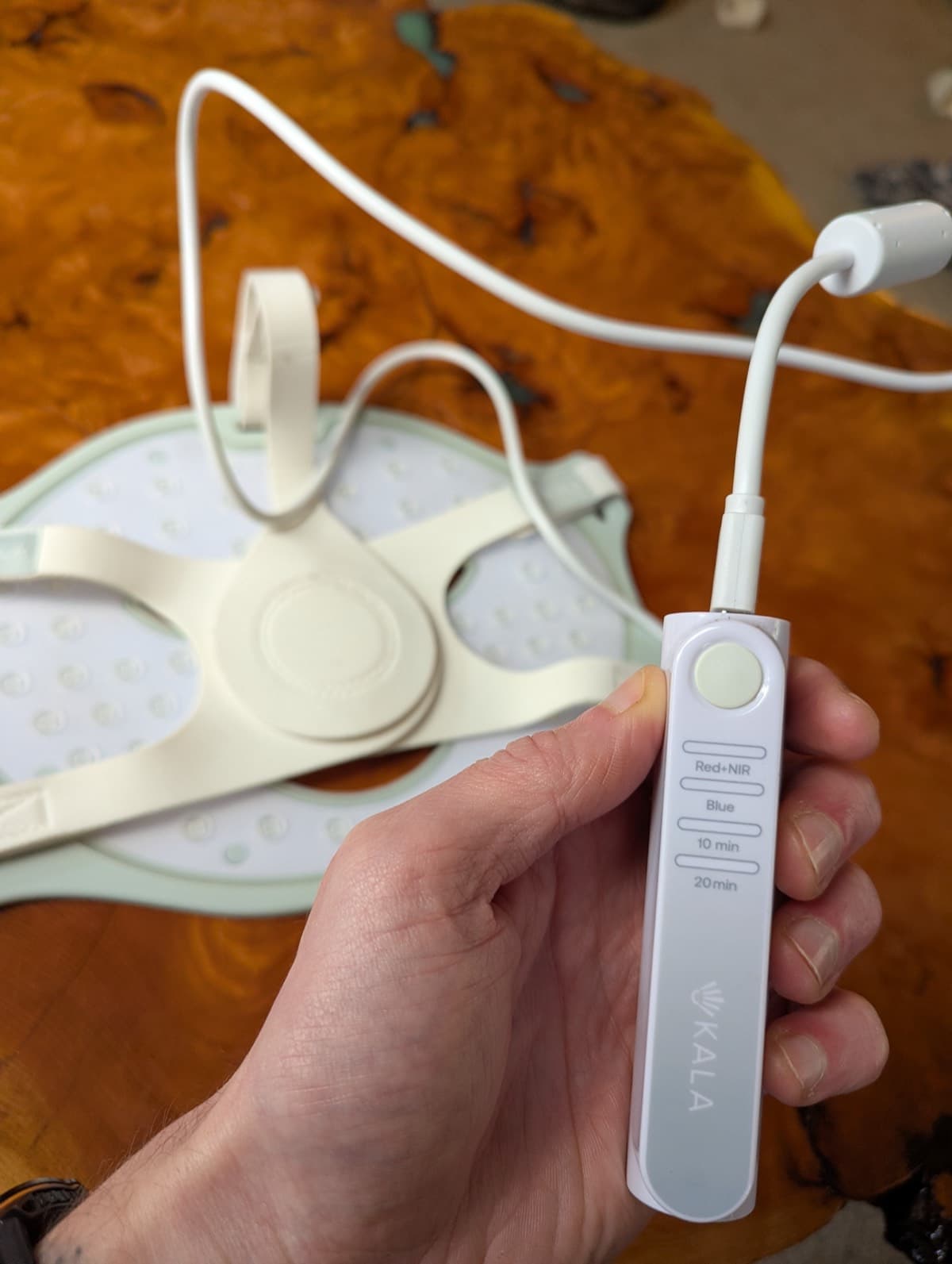
The medical-grade silicone conforms perfectly to facial contours. It avoids the rigid discomfort of budget plastic masks, ensuring optimal light contact across the entire face. Operation requires just one button, eliminating the need for buggy smartphone apps. It charges via a standard USB-C port in about four hours, and a single charge easily lasts through a week of regular sessions.
"I've reviewed the Omnilux Contour and CurrentBody specs in detail. Both are well-made masks with good clinical backing for anti-aging. But neither includes blue light, which means neither addresses acne biology. For patients dealing with hormonal breakouts alongside early signs of aging, I'm not aware of another mask at this price that handles both in a single treatment." — Daryl Stubbs, CAT(C), RMT, Holistic Nutritionist
Save 15% on Kala — Canadian-Designed, Medical-Grade
15% off applied automatically through this link
Kala mask vs Omnilux Contour vs CurrentBody Skin
| Feature | Kala Mask | Omnilux Contour | CurrentBody Skin |
|---|---|---|---|
| Wavelengths | 630nm + 830nm + 465nm | 633nm + 830nm | 633nm + 830nm |
| Blue light (acne) | ✓ Yes | ✗ No | ✗ No |
| LED count | 66 triple-chip | 132 single-chip | 147 single-chip |
| Red irradiance | 20 mW/cm² | ~105 mW/cm² (combined) | ~45 mW/cm² |
| Price (USD approx.) | ~$219-$249 | ~$395 | ~$380 |
| Material | Medical-grade silicone | Medical-grade silicone | Flexible panels |
| Warranty | 2 years | 2 years | 2 years |
| FDA-cleared | ✓ Yes | ✓ Yes | ✓ Yes |
| Canadian brand | ✓ Yes | ✗ No (US) | ✗ No (UK) |
When evaluating Kala against Omnilux Contour and CurrentBody Skin, the blue light is the deciding factor. Omnilux and CurrentBody are strictly for anti-aging. They ignore the bacterial component of acne. Kala handles both.
While Omnilux reports a higher combined irradiance, Kala utilizes 66 triple-chip LEDs, meaning each diode houses three distinct emitters. For a comprehensive breakdown of how these masks stack up, consult our best red light therapy masks guide. Dedicated head-to-head comparisons, including [Kala vs Omnilux](/blog/kala-vs-omnilux) and Kala vs CurrentBody, will be published soon.

Pros and cons
Pros
- ✓ Three therapeutic wavelengths — red, NIR, and blue in one device
- ✓ 66 medical-grade triple-chip LEDs with published irradiance specs
- ✓ FDA-cleared and Health Canada cleared
- ✓ Medical-grade silicone — flexible, skin-safe, comfortable fit
- ✓ USB-C charging — no proprietary cables
- ✓ 2-year warranty
- ✓ Lower price than Omnilux and CurrentBody
- ✓ Canadian brand — faster domestic shipping, local support
Cons
- ✗ Final sale — no 30-day return window
- ✗ Lower total irradiance than Omnilux by some metrics
- ✗ No pulse/mode settings — single operating mode
- ✗ Less clinical research pedigree behind the brand vs Omnilux's dermatology partnerships
Who should buy the Kala mask
I recommend this mask for patients navigating both acne and aging simultaneously. If you have hormonal breakouts alongside fine lines, this triple-chip LED system is your best option.
In my clinical practice, patients dealing with rosacea and facial redness show excellent responses to consistent red and near-infrared light treatment. Red and NIR light work synergistically to reduce skin inflammation and bolster the skin barrier. This therapeutic efficacy is well-supported by clinical data (de Freitas & Hamblin, IEEE J Sel Top Quantum Electron, 2016; PMCID: PMC5215870).
Who should skip it
Skip the Kala mask if your sole objective is pure anti-aging and you have zero concerns about acne. In that specific scenario, the Omnilux Contour offers a slightly higher combined irradiance for pure collagen stimulation. Additionally, if you require a 30-day return window to feel comfortable purchasing, Kala's final-sale policy will be a dealbreaker.
Recommended clinical protocol
For skin rejuvenation and anti-aging, I prescribe 3-5 sessions per week, lasting 15-20 minutes each. Apply the mask to clean, dry skin. Photobiomodulation works on biological timelines tied to collagen synthesis, so expect visible changes around the 8-12 week mark.
For active acne, daily use is safe and highly effective. The blue light channel carries no risk of over-treatment at normal session durations. Once your skin clears, drop down to a maintenance protocol of 3 sessions per week to sustain the cellular benefits.
My verdict
The Kala Red Light Face Mask earned its place in my clinical protocols. It tackles a broader spectrum of skin conditions than its dual-wavelength competitors. The build quality is robust, and the clinical outcomes I've observed in my practice are undeniable. For a comprehensive overview of Kala's entire product line, you can refer to my [full Kala Red Light Therapy review](/blog/kala-red-light-therapy-review).
If you are grappling with a combination of anti-aging concerns and active acne, this mask is unparalleled. It effectively tackles both issues in a single session, a capability that neither Omnilux nor CurrentBody devices offer.
"I'm selective about the skincare tools I recommend to patients. The Kala mask passed the 90-day test for me personally across acne and eczema. For anyone dealing with inflammatory skin conditions, or the combination of breakouts and aging, the triple-wavelength design is the correct clinical approach." — Daryl Stubbs, CAT(C), RMT, Holistic Nutritionist
Try Kala Risk-Free — 15% Off + Free Shipping
15% off applied automatically through this linkFrequently asked questions
How many LEDs does the Kala mask have?
The Kala Red Light Face Mask has 66 medical-grade triple-chip LEDs delivering three wavelengths: 630nm red at 20 mW/cm², 830nm near-infrared at 10 mW/cm², and 465nm blue at 10 mW/cm². Each LED chip contains three emitters — red, NIR, and blue — in a single diode, which is what "triple-chip" means. This differs from single-chip designs where each LED emits only one wavelength.
Is the Kala mask better than Omnilux?
For most users, yes. The Kala mask offers three wavelengths (red, NIR, and blue for acne) while Omnilux only offers two (red and NIR). Both are FDA-cleared with similar LED counts, but Kala's blue light gives it a wider range of skin benefits at a lower price point. If you have zero acne concerns and prioritize maximum irradiance for anti-aging only, the Omnilux Contour's higher combined output is worth considering. For mixed skin concerns, Kala wins on breadth of treatment.
How often should you use the Kala mask?
Most protocols recommend 3-5 sessions per week, each lasting 10-20 minutes. For active acne or accelerated anti-aging, daily use is safe with the Kala mask. Consistency over 8-12 weeks produces the most noticeable results. Once you've hit your target skin state, a maintenance protocol of 3 sessions per week sustains the improvement.
Does the Kala mask help with acne?
Yes. The Kala mask's 465nm blue light has antibacterial properties that target Propionibacterium acnes, the bacteria responsible for inflammatory acne. The 630nm red light adds anti-inflammatory effects that reduce the redness and swelling associated with active breakouts. A 2000 RCT published in the British Journal of Dermatology found combined blue-red light produced significant acne improvement over 12 weeks (Papageorgiou et al., PMID: 10809858). This is one of the main reasons I recommend the Kala mask over dual-wavelength competitors for patients with active acne.
Related Clinical Resources
- Recommended Guide: Read my full, hands-on review of the best red light therapy panels for deeper clinical insights.